
gravitational settling.
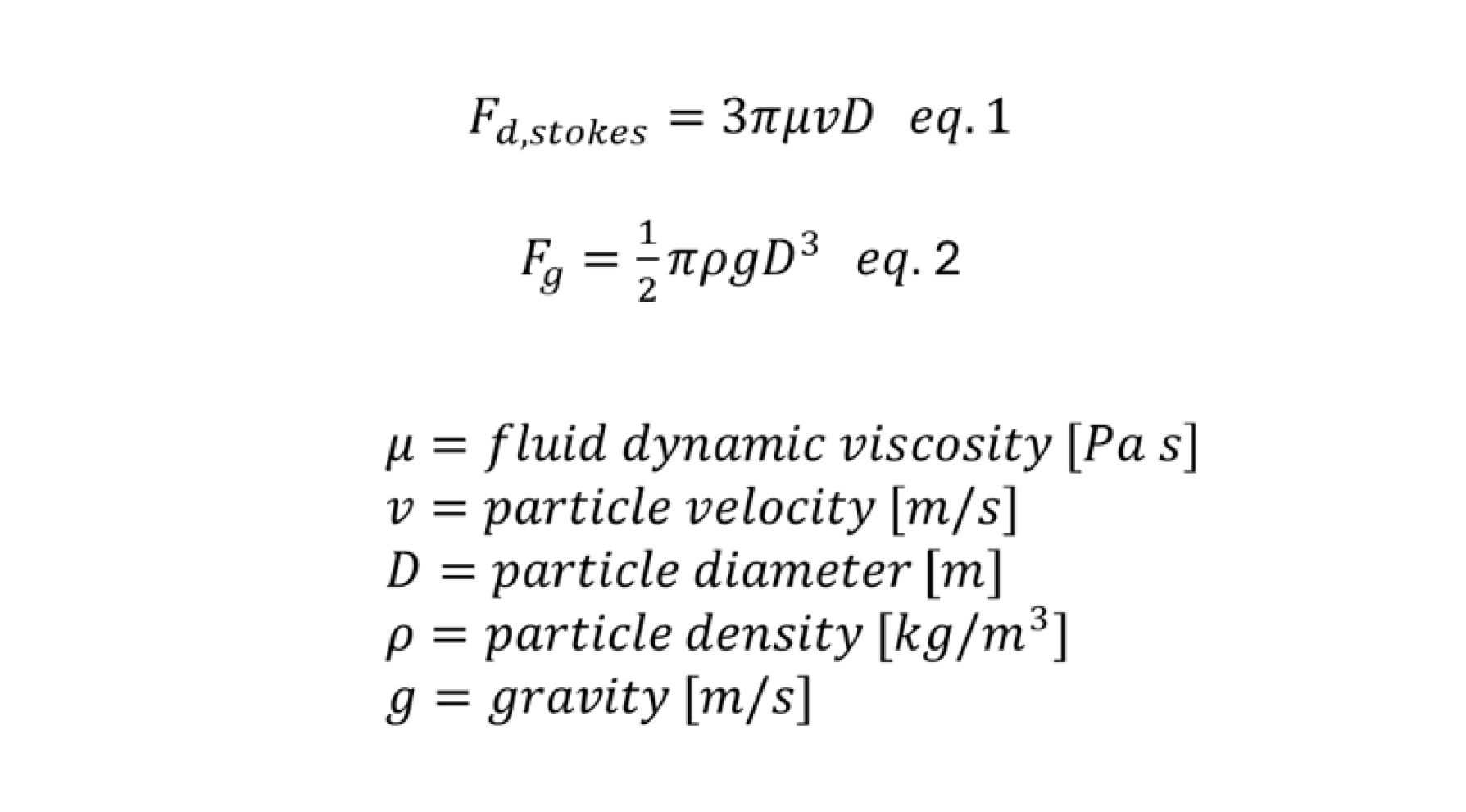
First, let’s dive deeper into gravity. All particles are subjected to gravity and in a stagnant medium they will slowly settle downwards. Settling of particles is an interplay between gravity and drag force. Small spherical particles in a viscous fluid experience Stokes drag. This drag force scales linearly with the particle diameter (equation 1), while the relation between gravity and particle diameter is cubic (equation 2). This is why gravity often can be neglected when very small spherical particles move through a viscous fluid.
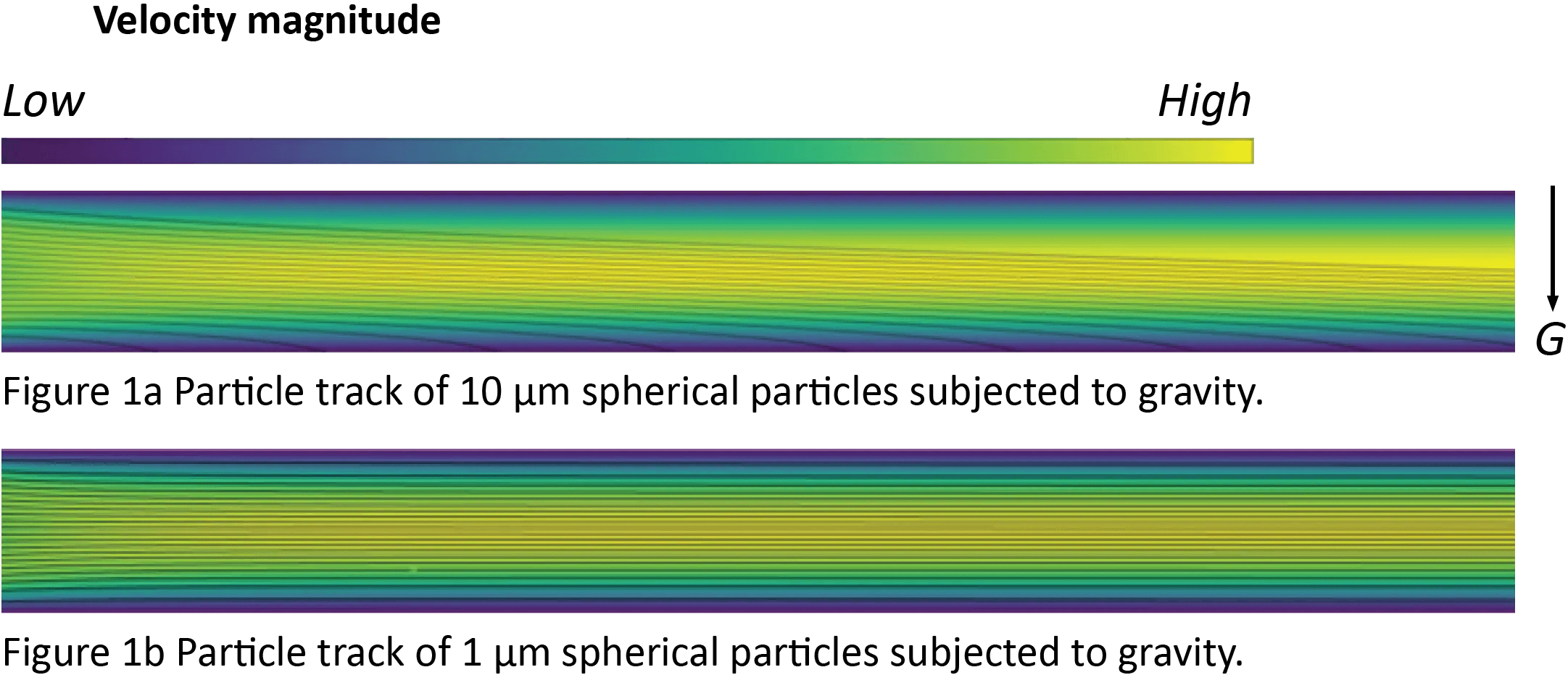
The influence of particle size on settling is visualized in figure 1. Figure 1a shows the trajectories of 20 spherical particles with a diameter of 10 µm in channel flow. The black particle trajectory lines show a drift towards the bottom, caused by gravity. While figure 1b shows the trajectories for smaller particles of 1 µm. The particles barely migrate downwards and leave the domain close to their initial height.
drag force correction.
Now let’s look at molecular effects. Motion of fluids is generally described by the Navier-Stokes equations. The ground hypothesis for this is that the fluid can be treated as a continuum rather than a collection of individual molecules. This hypothesis holds when the average distance a fluid molecule travels before hitting another (the mean free path) is a few orders of magnitude lower than other flow length scales (such as pipe diameter). The mean free path is dependent on density, temperature, pressure and molecule size.
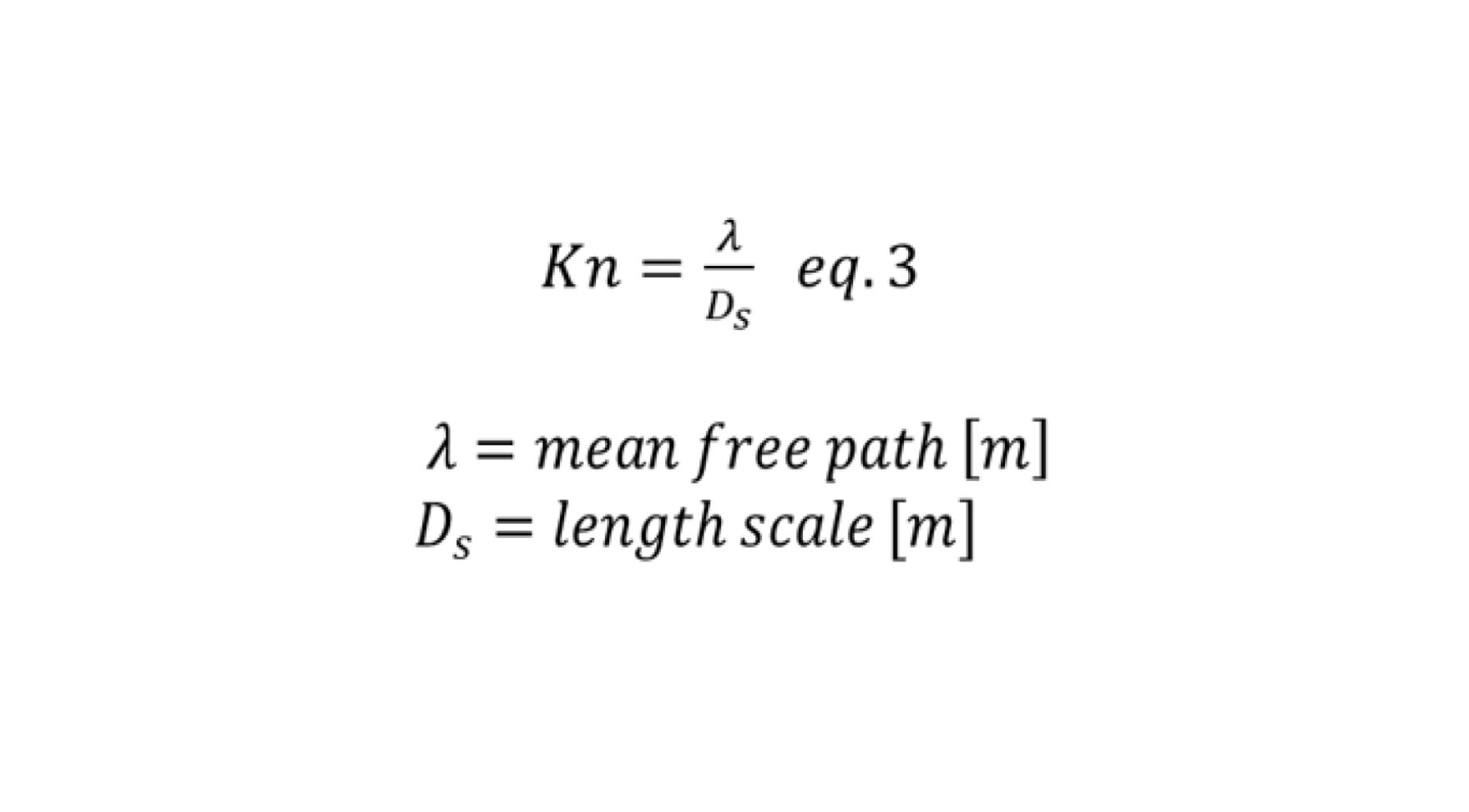
To verify whether the fluid can be described with standard Navier-Stokes, the dimensionless Knudsen number (equation 3) is used. The continuum hypothesis is valid when the Kn < 0.01. However, if Kn > 0.01, the fluid flow dynamics transitions into free molecular flow. In this flow regime, drag force on a particle is not caused predominantly by viscosity, but by individual random collisions with fluid molecules. Stokes drag (equation 1) is not valid anymore.
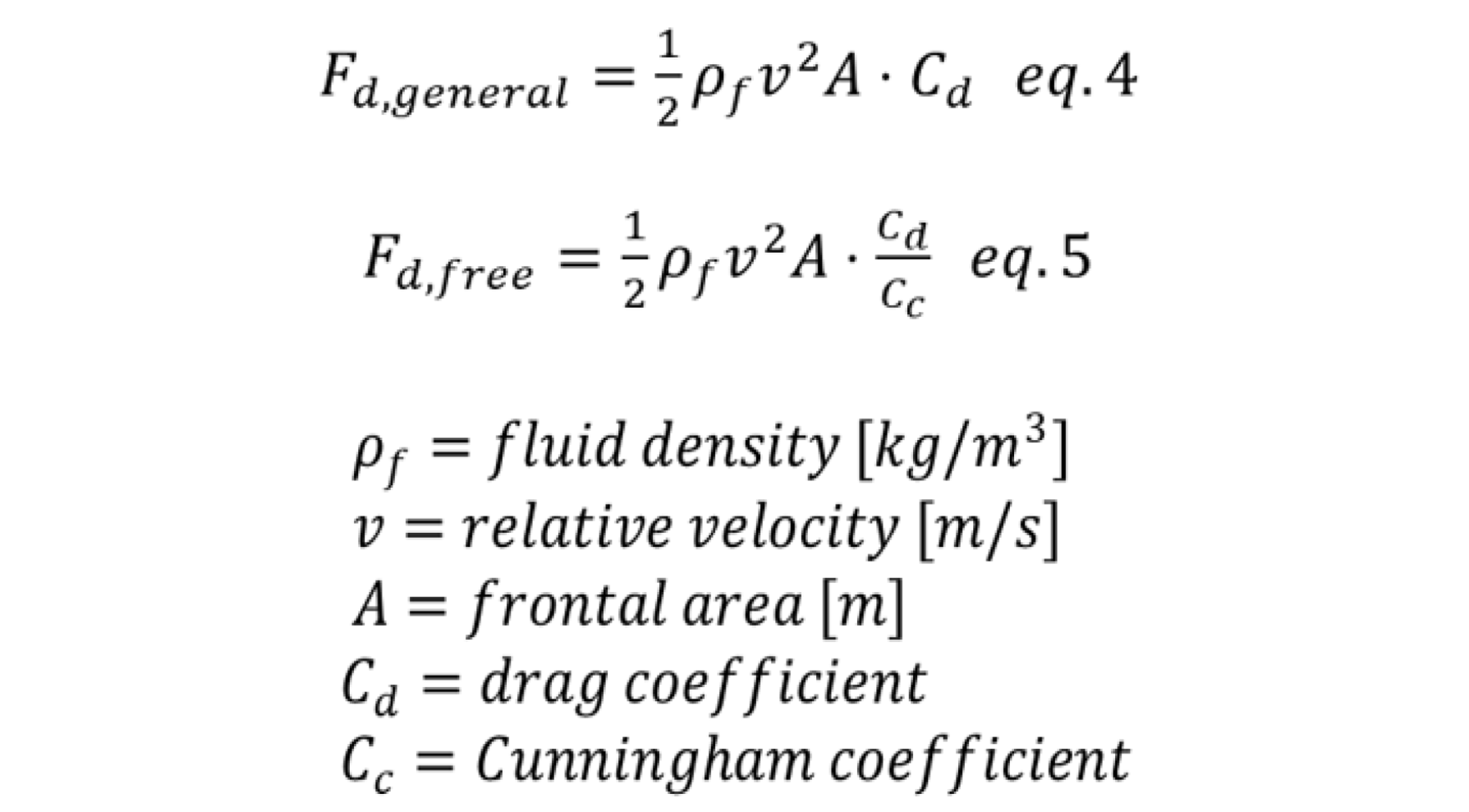
Motion of free molecular flow can best be described by adding a factor to the general drag force formulation (equation 4 and 5) that corrects for free molecular flow effects. This factor is called the Cunningham correction factor, and its influence can be seen in the following figures.
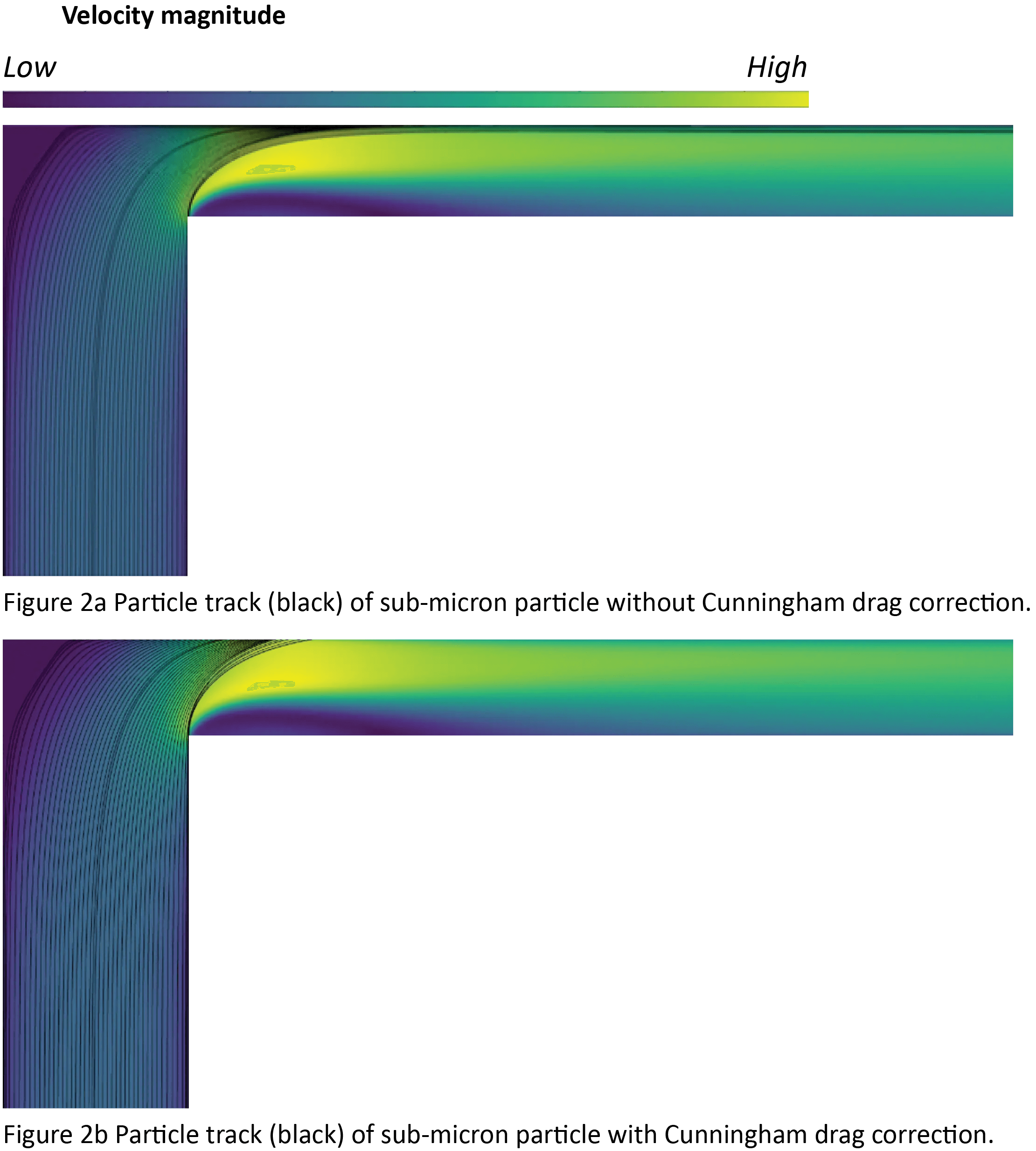
Sub-micron particles are injected into a gas flow, encountering a sharp bend. Small particles follow the flow nicely around the corner due to their low inertia. Only a few particles collide with the wall, but the majority exit the domain close to the wall (figure 2a). When the drag force on these sub-micron particles is corrected for the free molecular effects, the particles will not follow the flow around the bend and collide into the wall (figure 2b). The free molecular effects result in a reduction of the drag force on the particles, which causes the particles to spin out.
brownian motion.
Another molecule-level effect is Brownian motion. It is the random (statistical) motion of suspended particles due to collisions with molecules from the surrounding medium. Brownian motion introduces subtle fluctuations in the trajectories of individual particles, which may appear insignificant when considered individually. However, these random fluctuations result in a unique trajectory for each particle. As a result, when observing a larger group of particles, Brownian motion can lead to the dispersion of particle concentration. Moreover, the random movement can enhance the deposition of sub-micron particles that become trapped in slow-moving, viscous layers near solid surfaces.
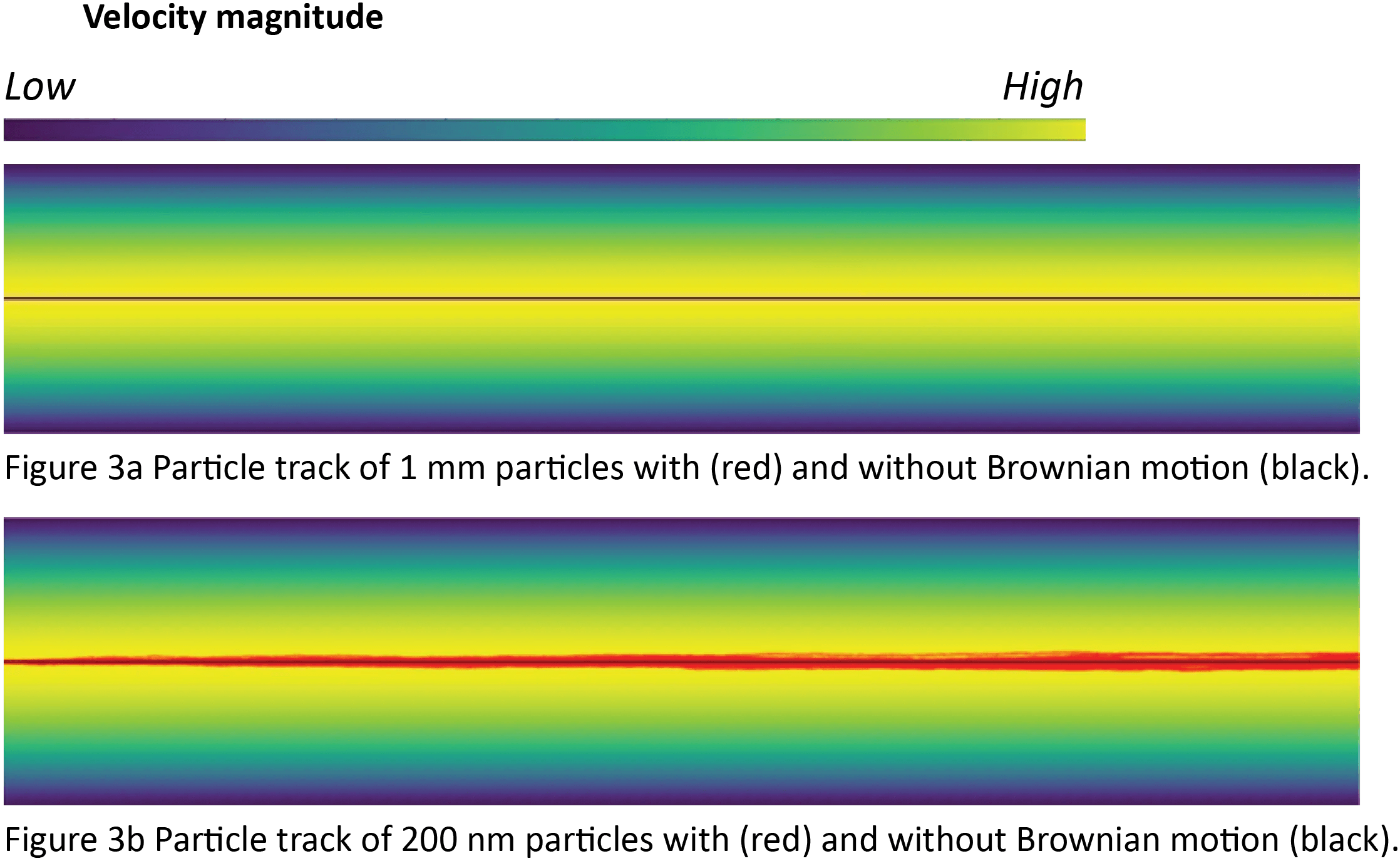
Figure 3 demonstrates the influence of Brownian motion on the individual trajectories of particles. Inside a gas channel flow a single particle without Brownian motion is released (indicated by the black line). At the same location 30 red particles with Brownian motion are released (indicated by red). The trajectory of the relatively large particles (1mm) in figure 3a are not affected by molecular collisions. In figure 3b it is clearly visible that Brownian motion causes the particles to migrate away from the channel center, while the particles are carried downstream. This is an example of the diffusive effect of Brownian Motion.
thermophoretic force.
Lastly, we consider thermophoretic force. This phenomenon takes place when the fluid, in which small particles are suspended, does not have a constant temperature. Thermophoresis is the migration of particles from a high temperature region to a lower temperature region. It has the same base as Brownian Motion: surrounding fluid molecules collide with the suspended particles. In the high temperature region, molecules have a higher velocity than those in the low temperature region. This causes a net force on the suspended particles, pushing them towards the low temperature region.
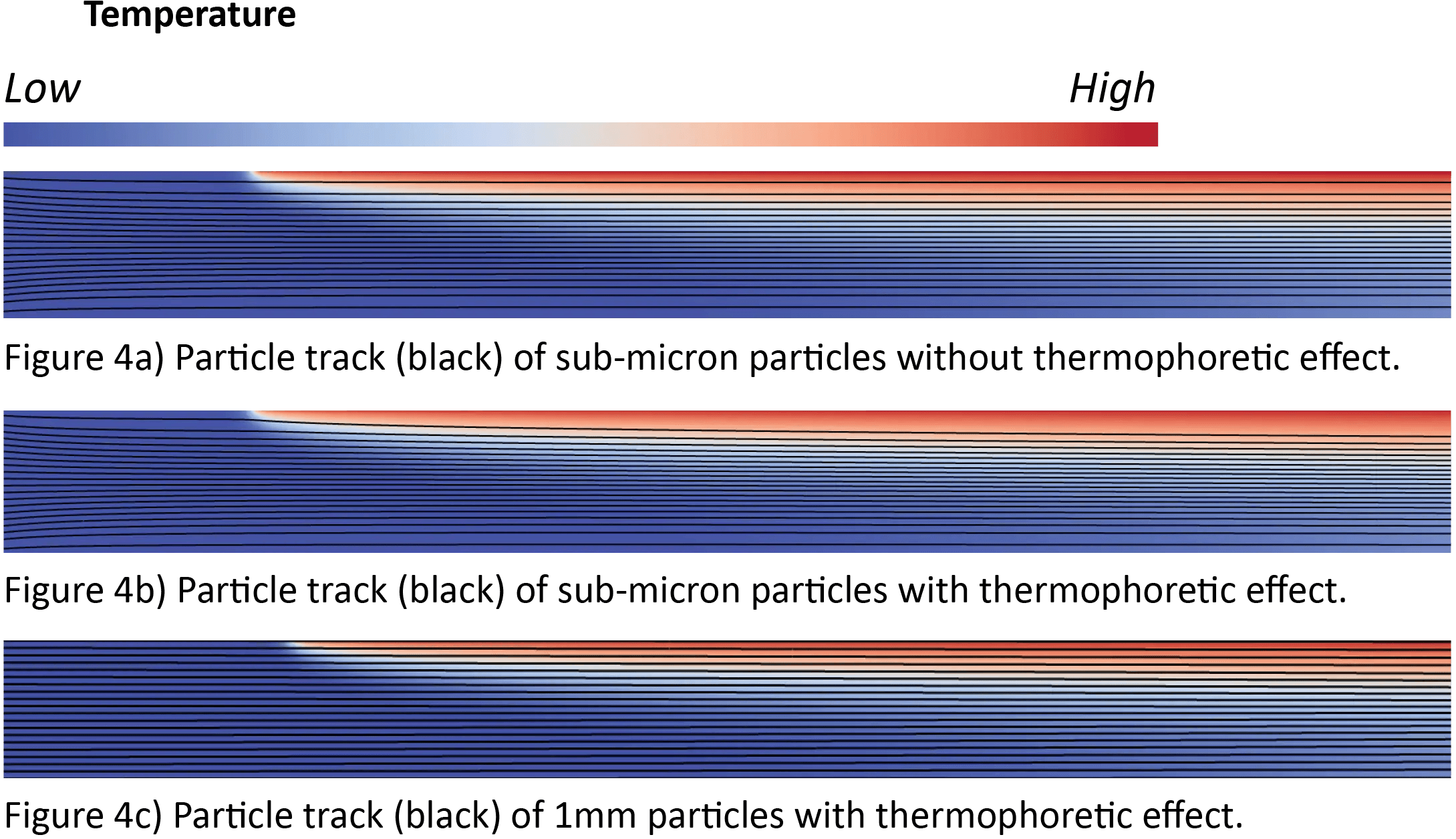
Thermophoresis can be observed in a channel with a partially heated wall as illustrated in figure 4. Heating the wall results in a temperature gradient in the fluid (gas). When thermophoresis is excluded from the simulation physics, particles of any size will move through the channel in a straight line, completely ignoring the temperature gradient. This can be seen in figure 4a. When the effect is included ánd the suspended particles are sub-micron (figure 4b), we start to see the particles moving away from the heated wall. Figure 4c shows that thermophoresis is not significant for all particle sizes.
summarizing.
We demonstrated the qualitative effect of gravity, drag, Brownian motion and thermophoresis on particle movement. Unlike for large particles (mm-range and larger), these phenomena may greatly alter the trajectories of sub-micron sized particles. When we deal with sub-micron particles in our projects, we evaluate the importance of each. This is because the significance of the individual forces can vary depending on the application or the scenario. Using the right assumptions in the formulation of the equation of motion of travelling particles in a simulation, we make sure results are as accurate as possible.
Are you dealing with extremely small particles and are you looking for more insight into their behavior in fluids? Let’s get in touch!