
what is the difference between sound pressure and sound power?
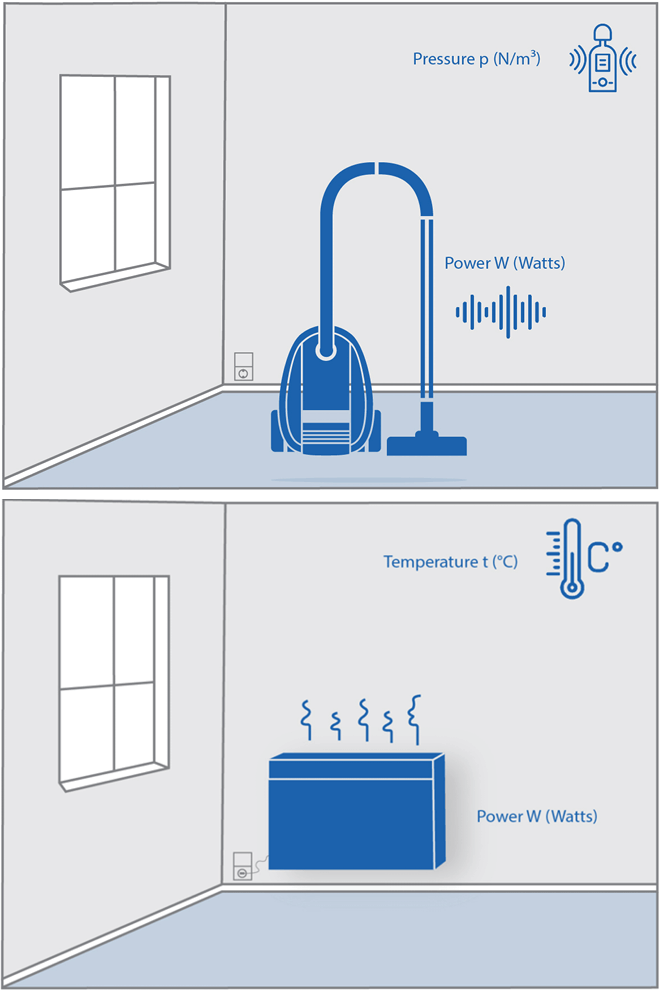
In principle, a sound source radiates sound power into an environment. This results in a sound pressure that our ears can detect. You can think of sound power being the cause and sound pressure the effect. The environment determines how the sound power relates to a sound pressure field.
A common analogy is a heating system. A heater radiates heat into the environment, but the temperature is the quantity that we measure. The value of this temperature depends on the environment. For example, keeping a room at a certain temperature requires less heat if the walls are well isolated.
The same is true for the emitted sound power by a sound source. The resulting sound pressure field depends for example on the size of the room and the sound absorption of the surfaces.
why is sound power important?
So, sound pressure is a result of the sound power emitted by a sound source and the environment. Putting the sound source in another environment will make the sound pressure change. On the contrary, changing the environment will in general have no effect on the emitted sound power. Hence, sound power is a quantity that defines the sound emission of the source itself and excludes the environmental effects. To assess whether a certain sound source is less loud compared to another, it is therefore important to consider the sound power instead of the sound pressure.
how do you measure sound power?
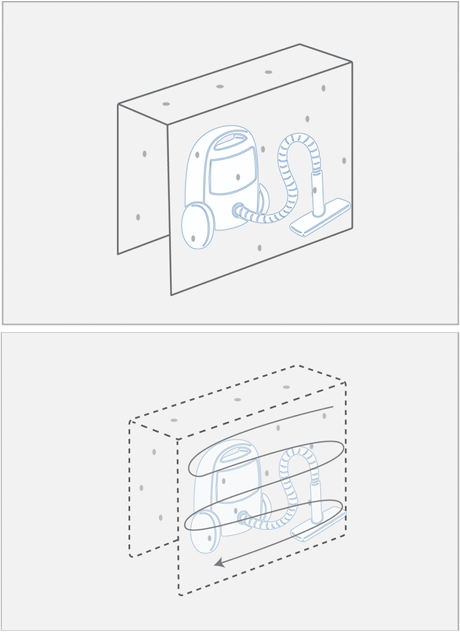
In an anechoic or reverberant room, the environment is well defined and (analytical) relations exist between the sound pressure and sound power. In these environments one can therefore determine the sound power of a sound source from sound pressure measurements. Very often the environment is not such an idealized environment. For those situations, for example in factory halls, one can use a sound intensity probe. The advantage of such a device is that you do not have to bring the sound source to a laboratory, but you can measure the sound power in-situ.
Compared to a conventional sound level meter, a sound intensity probe uses two microphones instead of one. These microphones are mounted face to face with a spacer in between such that the device can measure both the sound pressure and particle velocity. Sound pressure is simply the average of both microphone signals, while the particle velocity is determined using a so-called finite difference approximation. The (time-averaged) product of both quantities is the sound intensity and the sound power can be obtained by integrating the sound intensity over a surface enclosing the source. In practice, one can extract the area-averaged sound power in two ways: by doing discrete point measurements (according to the ISO 9614-1 standard) or by making scanning measurements (according to the ISO 9614-2 or ISO 9614-3 standard). Multiplying each measurement with the corresponding area and summing all contributions gives the sound power.
summarizing.
To conclude, sound power is the cause and sound pressure the effect. The sound power of a sound source is in general independent of the environment and therefore quantifies the source itself. One can use a sound intensity probe to measure the sound power of a source in-situ, such that you do not have to bring the sound source to a laboratory.
Do you want to quantify or compare sound sources? We have plenty of experience with our B&K sound intensity probe, so get in contact with us!