

loudness.
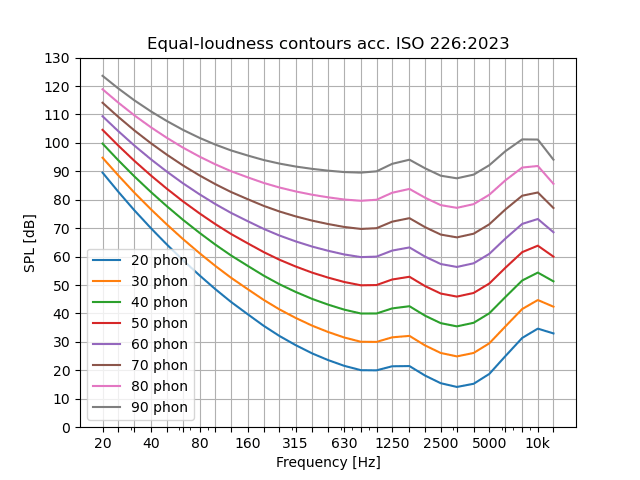
Loudness is an objective measure of the subjective perception by human beings of true SPLs. In fact, our ears are more sensitive to certain frequencies than to others. For example, a 40 dB SPL tone at 1000 Hz is perceived louder than a 40 dB SPL tone at 100 Hz. This is illustrated by the equal-loudness contours as shown on the left, where phon is the unit for loudness. As you can see, this sensitivity is also dependent on the SPL. Now, if you follow one of the contour lines in the figure, you can see that to achieve the same loudness at 20 Hz compared to 1000 Hz, a higher SPL is needed. This is also a reason why some people like to play their music louder: it will enhance the bass!
frequency weighting.
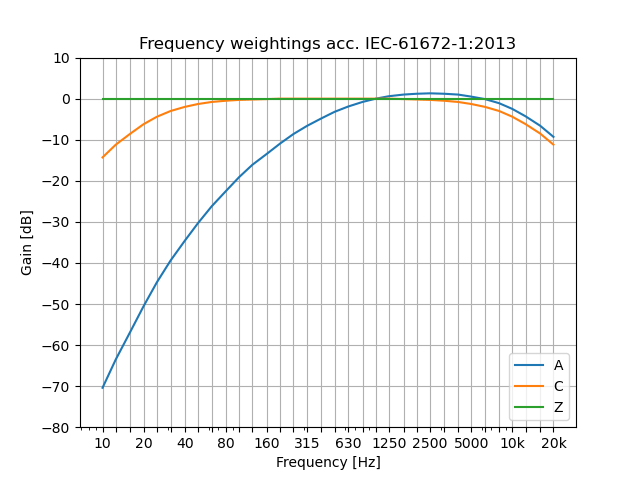
Frequency weighting is an attempt to correct for this subjective perception of sound pressure levels. As this perception is dependent on the absolute level of the sound pressure as well, different frequency weightings are available. A-weighting weights a signal in a manner which approximates to an inverted equal loudness contour at low SPLs. C-weighting does the same but for high SPLs. And Z-weighting is just a way of stating that no frequency weighting is applied. In the past, also B- and D-weightings were available, but they have fallen in disuse nowadays. By applying a frequency weighting to a sound pressure signal, one can obtain an SPL which is closer to the subjective perception of human beings.
measuring sound.
A sound level meter can measure the true sound pressure by using a condenser microphone. To account for the subjective perception of human beings, a sound level meter applies filters to this signal with the characteristics of one of the frequency weightings. Sometimes also a so-called time weighting (i.e. Fast or Slow) is applied. These are used to smooth heavily fluctuating sound levels in time. In the past, this was the only way to get a meaningful reading of the SPL as sound level meters were analogue. Nowadays, most sound level meters are digital, and frequency-weighted signals can simply be time-averaged by determining the root-mean-square value after a measurement. This is called the equivalent continuous sound and can be seen as a measure of the perceived loudness.
summarizing.
We have shown that loudness is the subjective perception of SPLs by human beings and that frequency weighting is an attempt to correct for this. A sound level meter incorporates this by applying filters to the signal with the characteristics of one of the frequency weighting curves. By time averaging this weighted signal, the continuous sound level is determined, which is now a measure of the loudness.
Do you want to quantify sound pressure levels which approximate loudness? We have plenty of experience with our B&K class I sound level meter (with specifications according to the IEC 61672-1 standard), so get in contact with us!