
PECVD processes take place in a process chamber, which is under vacuum at pressures from roughly 0.1 Pa to 100 Pa. The substrate is located inside the chamber. Thin film deposition is achieved by means of generating a plasma that drives chemical reactions in which high purity materials are created. Common methods to generate the plasma are by means of electrodes or high-frequency electromagnetic waves. Since the chemical reactions take place in the plasma, PECVD can guarantee a homogenous deposition over the desired deposition area. Varying the plasma properties allows for control over the deposition process.
To model PECVD processes, plasma models can be coupled to many different types of physics, such as electromagnetism, fluid flows, and heat transfer. For LeydenJar, we simulated a hydrogen plasma that is sustained by a microwave source.
coupling plasma physics to a microwave source.
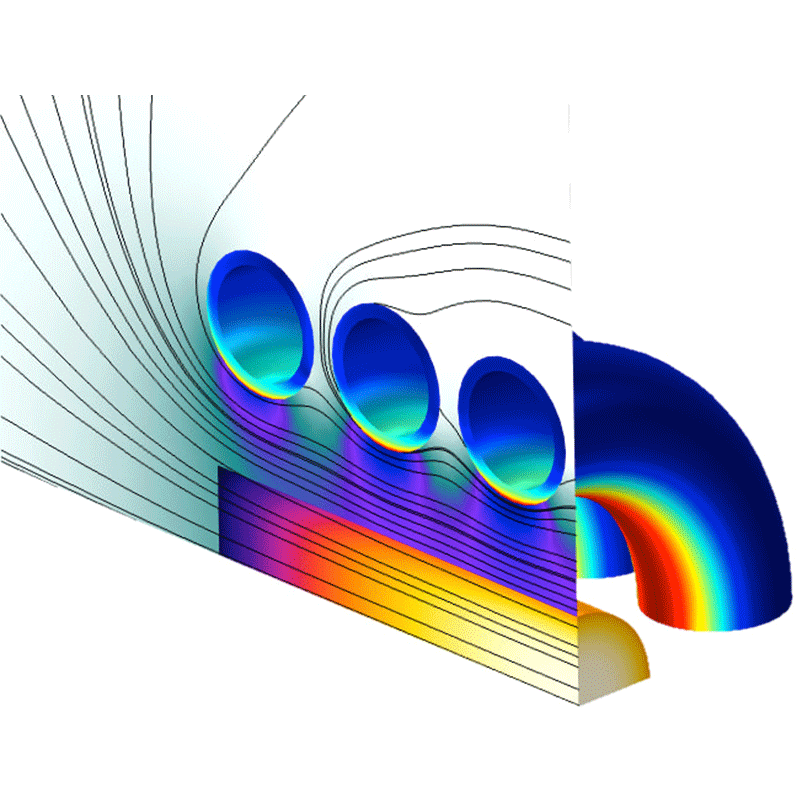
The system that was modelled consists of a cylindrical coaxial waveguide carrying a microwave. The plasma is generated in a cylindrical vacuum vessel around the waveguide.
To model the plasma, a model was set up in COMSOL Multiphysics in which the microwave and the plasma were coupled. Since plasma simulations are computationally demanding, the choice was made to set up a two-component model in which the microwaves were modeled in a 2D-axisymmetric component, whilst the plasma was modeled as a 1D-axisymmetric radial component perpendicular to the waveguide. With this setup the plasma properties as a function of the distance to the waveguide could be obtained, which was our main interest.
For the hydrogen plasma several H-species were considered (a.o. H, H*, H**, H+, H2, H2+, H3+). The reaction rates were computed based on imported cross sections and rate coefficients, as well as the electron energy distribution function (EEDF). The EEDF can either be assumed a Maxwellian distribution, which is a function of the electron temperature only, or be computed by solving the Boltzmann equation.
Computing the EEDF is very computationally expensive compared to assuming an analytical EEDF, as the EEDF is then solved at each point on the mesh. However, this can give more insight in cases where the EEDF deviates from a Maxwellian distribution.
The propagation of the microwave through the waveguide depends on the conductivity of the plasma. At the same time, the microwave is the heating source of the electrons in the plasma, affecting the conductivity. By coupling the two components and exchanging the required quantities, a self-consistent model could be set up.
results.
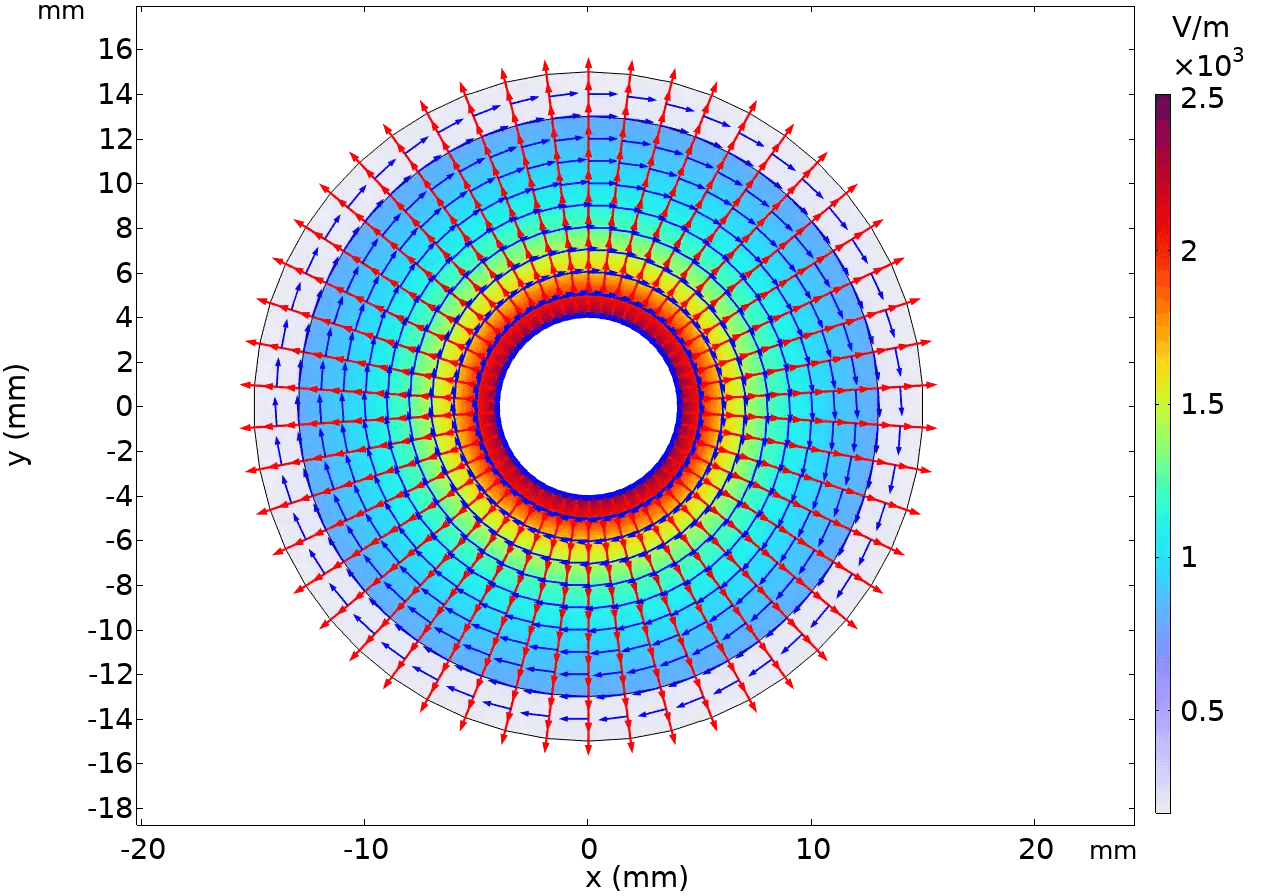
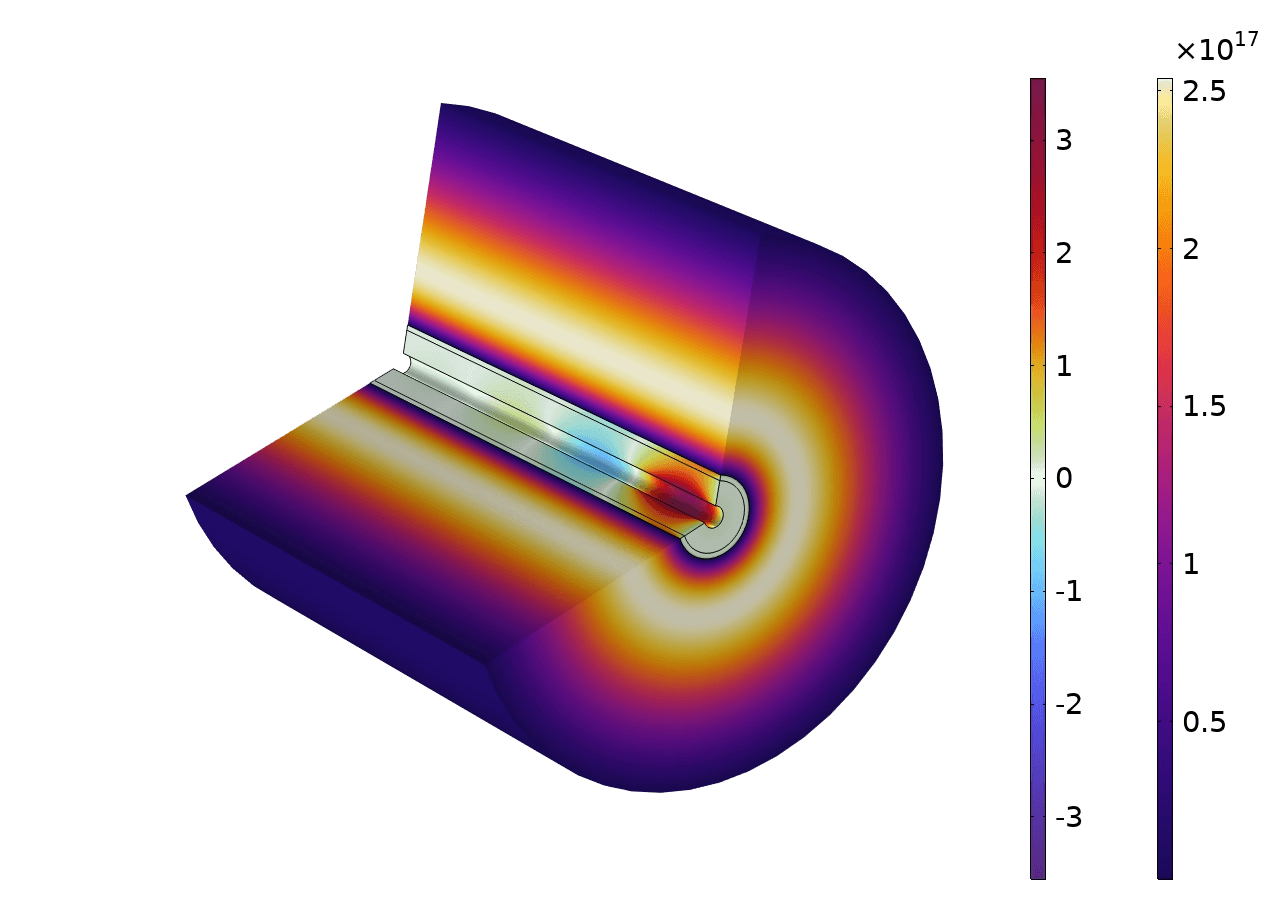
First, the eigenmodes of the waveguide were determined. At the considered frequency, the waveguide only supports a single propagating eigenmode, and the microwave in the waveguide was assumed to be in this eigenmode, shown in Figure 1. The microwave sustains the plasma around the waveguide.
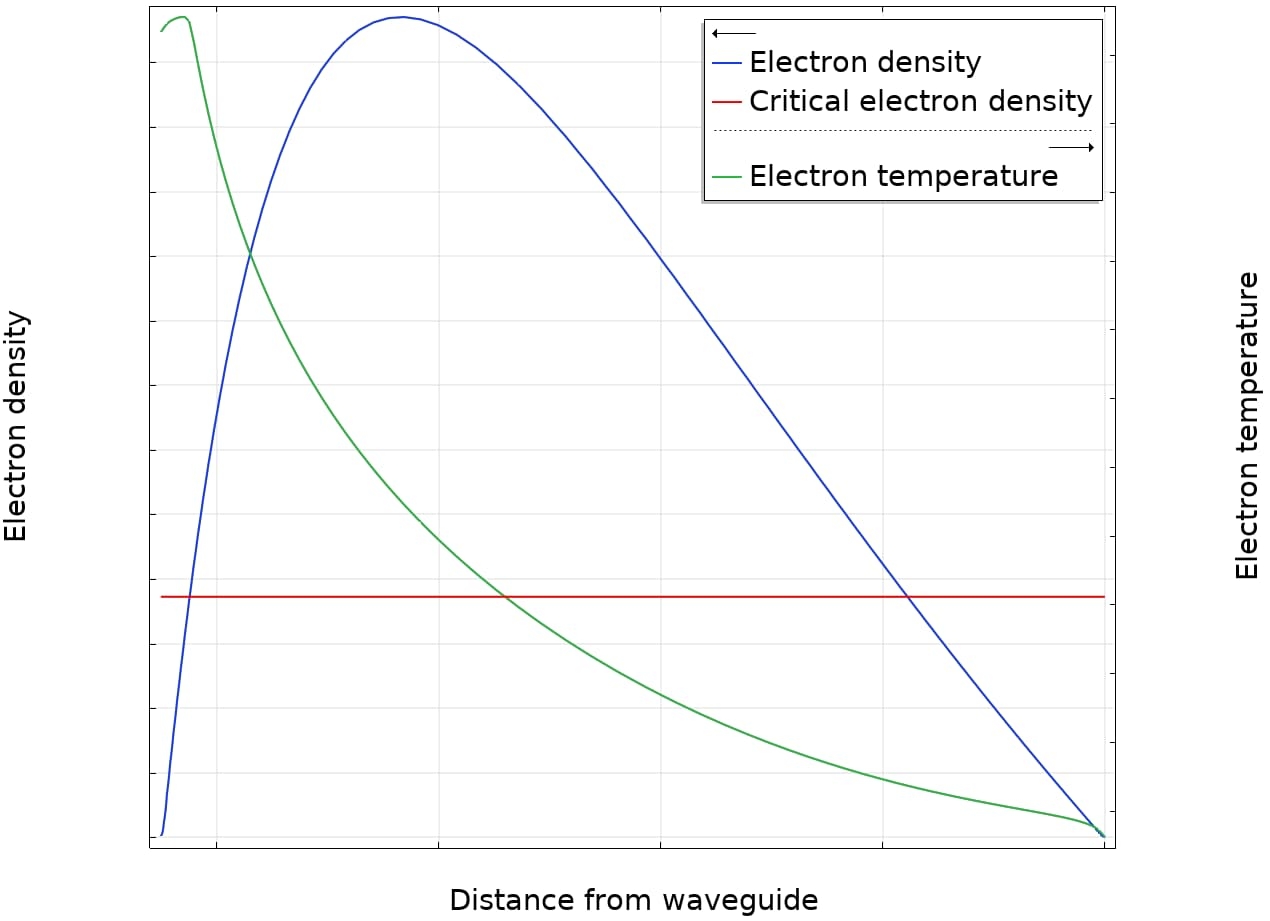
From the model, information about many different parameters was extracted. Examples are the electron density and electron temperature as a function of the distance to the waveguide, shown in Figure 2. The critical electron density has been indicated by the red line. If the electron density lies above the critical density, the microwave cannot propagate further from the waveguide into the plasma. It was in the region near the waveguide where the electron density is equal to the critical density that the microwave power was deposited and where the electron temperature was highest.
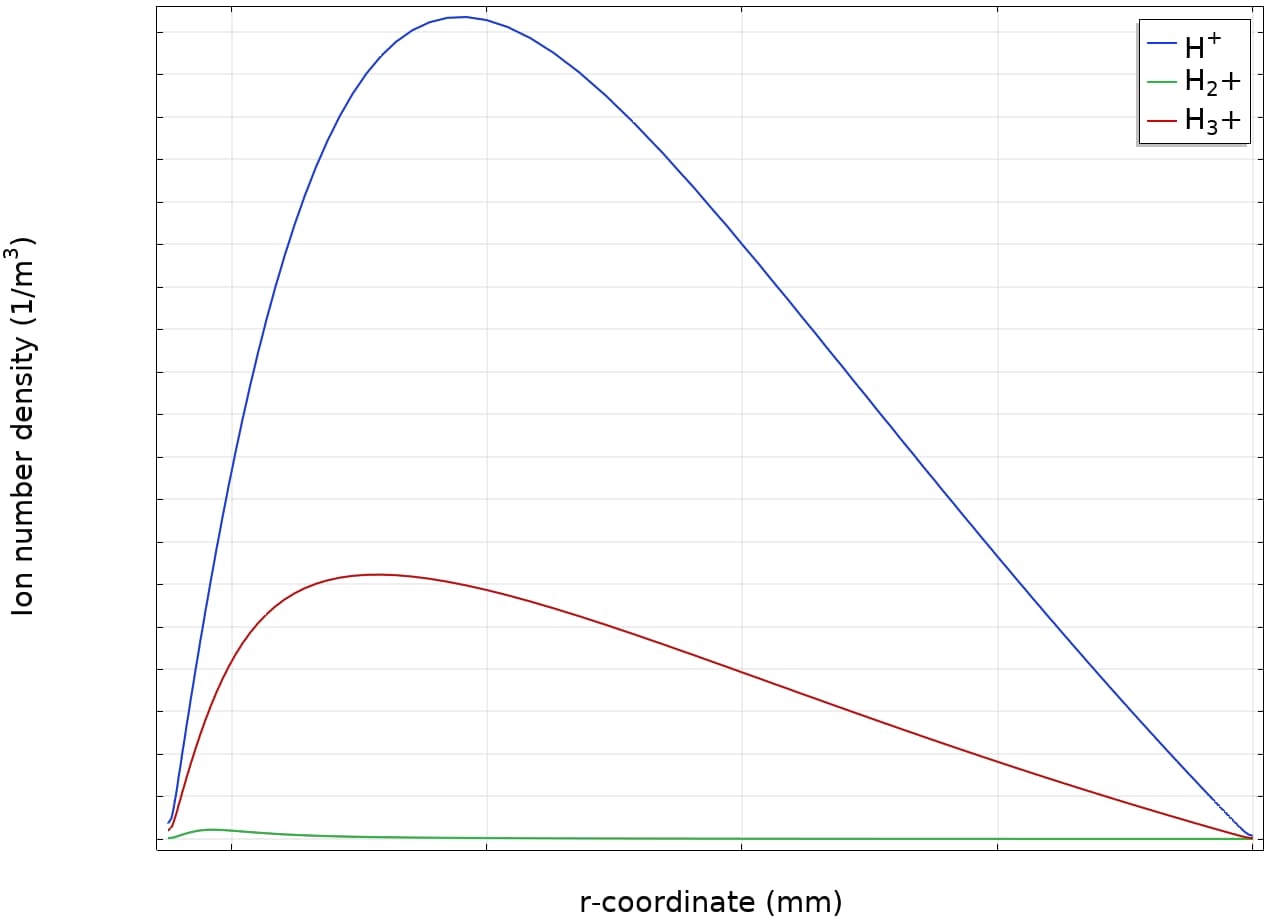
To obtain insight in a PECVD process, one generally also wants to have insight in how ions or other reactive species distribute themselves through the plasma. As an example, Figure 3 shows the densities of the different hydrogen ions as a function of the distance to the waveguide. There are (generally) many more quantities of interest that can be extracted from a model, which cannot possibly all be shown here. Some examples include reaction rates, the plasma potential, the EEDF, transport parameters of electrons and heavy species, and the degree of ionization. If desired, one can also include a surface chemistry model and compute deposition rates.
At LeydenJar, our models made an impact in three different
ways:
- As illustration: to understand the basic principles of the plasma source.
- As inspiration: to help explain experimental observations.
- Further development: to test assumptions in simpli ed models.
In conclusion, plasma simulations provide a powerful tool for accurately modeling complex plasma behaviour and chemical reactions that take place in a plasma, enabling deeper insights into both fundamental physics and practical applications in semiconductor processing.
"plasma is very multiphysics"
For these simulations, there was a strong coupling between the microwave and the plasma. Additional complexity lied in the computational requirements for simulating a plasma. I found it very satisfying to solve these challenges. Working closely together with LeydenJar, the results of these simulations aided them in understanding and improving their system.